Kowloon City – Kowloon Walled City Park ca.1910

360-degree panoramic artwork developed from historical photos
Historical Hotspots:
The Mural Wall and Fui Sing Pavilion

Kowloon City District has one of the densest distribution of schools in Hong Kong, with a network of traditionally elite schools nestled near the Kowloon Walled City Park. The district’s rich educational landscape can be traced back to the early days of the Walled City, when officials established Longjin Charitable School and built the Fui Sing Pavilion. Standing opposite the school gate is a large mural wall, engraved with the four characters ‘Haibin Zoulu’, symbolising this cultural and educational complex.
The phrase ‘Haibin Zoulu’ translates literally to ‘the states of Zou and Lu at the coast’ meaning ‘a school at seaside serving as a place nurturing great wisdom’. ‘Zou’ and ‘Lu’ (located in present-day Shandong) existed during the Spring and Autumn Period and the Warring States Period respectively in ancient China. They were home to the renowned thinkers and educators Mencius and Confucius. Subsequently, ‘Zoulu’ signified places where education and culture flourished. Since Kowloon Walled City was originally close to the coast, the characters ‘Haibin’ were added. As for the Fui Sing Pavilion, it was originally dedicated to Man Cheong, the God of Literature, who presides over studies, particularly in preparation for the Imperial Examination, which students took in the hope of becoming officials. Man Cheong pavilions were built by local officials throughout China to manifest the intellectual cultivation. In keeping with these traditions, a replica mural wall painted with the characters ‘Haibin Zoulu’ was erected near the east gate of Kowloon Walled City Park.
Photo courtesy of Public Records Office, Government Records Service
Longjin Charitable School

How did the Qing Government attract families from adjacent areas to move into the new Walled City? The Qing Government established schools as a key strategy to promote education and community development, attracting residents to settle.
At the time, garrisoned officers and troops were stationed in the Kowloon Walled City. The Qing Government encouraged people to settle in the Walled City and engage in farming to make a living as well as supporting the local administration. In 1847, the Qing Government established Longjin Charitable School, which provided free education to attract residents to relocate to Kowloon Walled City and as well promoting education, amidst the atmosphere that people put emphasis more on doing business than learning at school. The school also served as a gathering space, where residents could discuss public affairs, like the modern ‘village office’.
However, in the 20th century, the school faced quite some ups and downs. In 1898, the British Hong Kong Government took over areas north of Boundary Street in Kowloon, resulting in the officials in the Walled City being withdrawn. The school ceased operations, but it was revived for a short period of time. In the 1970s, the school was demolished and replaced by a residential block named after it – the ‘Yi Hok’ (Charitable School) Building. When Kowloon Walled City was transformed into a park, the building was demolished. However, a stone plaque engraved with the name ‘Longjin Charitable School’ and a pair of couplets have been preserved to this day.
Photo courtesy of Hong Kong Museum of History
Office of the Kowloon Assistant Military Inspectorate, commonly known as the Yamen, or headquarters

The lintel of the Office of the Kowloon Assistant Military Inspectorate is engraved with the English term ‘ALMSHOUSE’ and the Chinese phrase, ‘Kwong Yem Home’ (meaning a place that shelters and cares for impoverished and helpless elderly people). How did the Inspectorate’s Office become an almshouse?
When the Qing Government ceded Hong Kong Island to the British, after the Opium War of 1842, the Daoguang Emperor ordered the construction of Kowloon Walled City to strengthen the military defence of Kowloon. Soldiers were stationed in the Kowloon City, while the official in charge of law and order of Kowloon City was titled as the ‘Kowloon Assistant Military Inspectorate’. To house the inspectorate, a government office was built in the centre of Kowloon Walled City in traditional Chinese style, consisting of a three-hall structure with two internal courtyards. The office handled local affairs of the Kowloon Peninsula and the New Territories, such as exchanging information with the British Hong Kong Government, combating piracy in Hong Kong waters.
In 1898, as the British Hong Kong Government took over areas north of Boundary Street in Kowloon. In the following year, the Chinese officials stationed in the Walled City all left. The office was abandoned until 1902, when the Anglican Church turned it into ‘Kwong Yem Home’ to support elderly people without dependents. The church also set up a free school for children from impoverished families. After 1918, the building served various charitable functions, including an elderly home, an orphanage and widows’ shelter, a school and a medical clinic. It operated as an elderly centre from the late 1970s until the demolition of the Walled City.
In 1987, the demolition of Kowloon Walled City began, paving the way for the development of Kowloon Walled City Park, which officially opened in 1995. The Office of the Kowloon Assistant Military Inspectorate remains in its original location and now hosts exhibitions that introduce the history of the Walled City. Docent services are available to introduce visitors to and narrate the history of the Walled City. Since May 2025, an exhibition titled ‘Kowloon Walled City: A Cinematic Journey’, which is a movie set exhibition, has been set up in the park, showcasing film sets from the movie Twilight of the Warriors: Walled In (2024), and reconstructing daily scenes inside the Walled City in the 1980s.
Photo courtesy of Hong Kong Museum of History
Major-General’s Mansion

The largest building complex in Kowloon Walled City was the mansion of the Commodore of the Dapeng Naval Brigade, the person in highest rank in charge of Kowloon Walled City. It was also known as the ‘Major-General’s Mansion’.
After the cession of Hong Kong Island to the British in 1842, Kowloon became the front line of the Qing Government’s defence, resulting in the construction of Kowloon Walled City. Upon its completion in 1847, the Commodore and his Dapeng Naval Brigade, initially stationed at Dapeng Bay in Guangdong, were relocated to Kowloon Walled City. The Major-General’s Mansion was built to serve as both his residence and office.
In 1899, after the British army occupied the Walled City, they expelled the Qing soldiers and closed the Kowloon Customs. Consequently, the Mansion was abandoned and the Walled City was no longer used as a military base, becoming a residential area instead. In 1906, the abandoned mansion was converted into the Hong Kong Anglican Church for prayer and worship.
In 1940, after walls of Kowloon Walled City collapsed, the Government demolished most structures in the Walled City for reason of hygiene, which included the Major-General’s Mansion, yet except the Office of the Kowloon Assistant Military Inspectorate and Longjin Charitable School. Today, only the Office of the Kowloon Assistant Military Inspectorate has been preserved in situ.
Photo courtesy of Special Collections, University of Bristol Library.
South Gate and City Wall of Kowloon Walled City
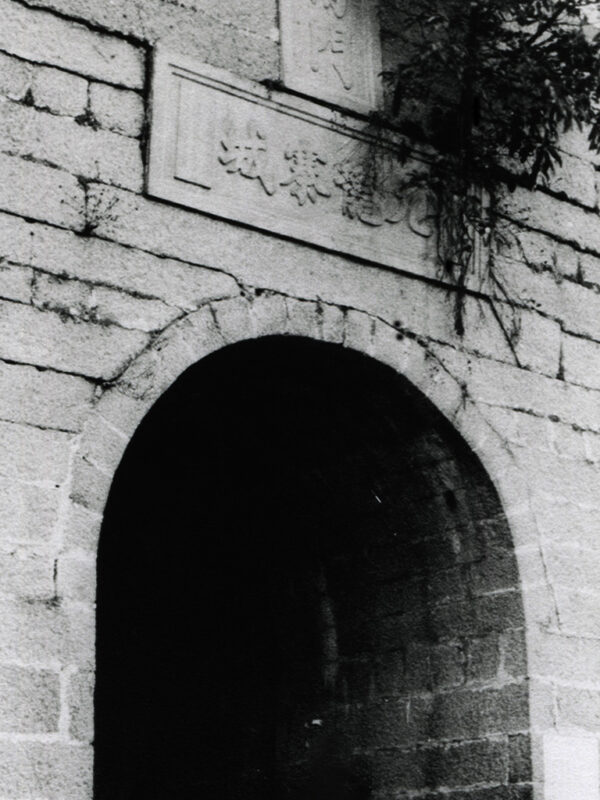
The term ‘Kowloon Walled City’ is written in Chinese in various ways, yet all referring to the same historical site. The naming variations, seen in movies, books, and references to the current Kowloon Walled City Park, originate from the historical changes in the area’s walls and gates.
This area was inhabited long before the construction of Kowloon Walled City. In the early 19th century, the Qing Government established military outposts along the Guangdong coast to defend against pirates, including the Kowloon Battery, which gave rise to settlements like ‘Kowloon Chai’ (九龍寨) where the Chinese character ‘寨’ (Chai) denoted a place for military purposes.
After the signing of the Treaty of Nanjing in 1842, which ceded Hong Kong Island to Britain, the Qing Government fortified its border defences by ordering the construction of walls and batteries at Kowloon Chai in 1843. Over four years, the walls and batteries were completed, with gates at the east, south, west and north, turning the area into a ‘walled city’. Thus, there came the name Kowloon Walled City (九龍寨城). Interestingly, the ‘South Gate’ was actually located to the southeast rather than south, possibly for feng shui (Chinese geomancy) and topographical planning reasons. Its proximity to Lung Tsun Pier made it the main entrance to the Walled City.
During the Japanese occupation, however, the walls were completely demolished, and some of the granite was repurposed by the Japanese army as building material for the expansion of Kai Tak Airport. After the war, the name ‘Kau Lung Shing Chai’ (九龍城寨) gradually became the most widely used one.
Interestingly, the Chinese name of the Walled City historically coexisted with different written forms. For instance, a 1917 stone tablet at Hau Wong Temple in Kowloon City bears the inscription ‘九龍砦’ (Kowloon Chai) , while older residents of Kowloon City commonly used ‘九龍城砦’(Kau Lung Shing Chai), as seen in the Kowloon Walled City Kai Fong Welfare Promotion Association established in 1963. The choice of the Chinese character ‘砦’, with the element of 石 (stone), reflecting the fact that the Walled City was originally built with stone walls.
It was only during the demolition of Kowloon Walled City in the early 1990s that stone plaques bearing the inscriptions ‘South Gate’ and ‘Kau Lung Chai Shing’ (九龍寨城) were discovered, confirming the latter as the official name during the late Qing period. Today, remnants of the ‘South Gate’ can still be seen near the southern entrance of Kowloon Walled City Park.
Photo courtesy of Hong Kong Museum of History
Movie Hotspot:
CITY IN TIME incorporates cinematic elements at designated locations. Check out these filming locations of Hong Kong movies, where you can revisit classic Hong Kong movie clips on-site or stills on the website:
Days of Being Wild

Days of Being Wild was released in 1990 and directed by Wong Kar-wai. It showcases a stardust lineup of iconic Hong Kong actors, including Leslie Cheung, Maggie Cheung, Andy Lau, Carina Lau, etc. The following year, the film received 9 nominations and won several awards including the Best Film, Best Director and Best Actor (Leslie Cheung) at the 10th Hong Kong Film Awards. It also took the third place in the Best 100 Chinese Motion Pictures by the Hong Kong Film Awards Association in 2005.
Set in the 1960s, the narrative centers on Yuddy (Leslie Cheung), exploring themes of love and friendship, the people he encounters and his journey to find where he is from.
The footage shows the final scene, featuring a surprise appearance by Tony Leung. It was filmed inside the Kowloon Walled City.
Courtesy of Media Asia Film Distribution (HK) Limited
Twilight of the Warriors: Walled in

Released in 2024, Twilight of the Warriors: Walled in is the second Hong Kong film reaching a box office gross over 100 million Hong Kong dollars in the history of Hong Kong movies. The film was selected for screening in the “Midnight Screening” section of the 77th Cannes Film Festival, and it was Hong Kong’s official entry for Best International Feature Film at the 97th Academy Awards. At the 43rd Hong Kong Film Awards, the film received 14 nominations and won 9 awards including the Best Film, Best Director (Soi Cheang), Best Film Editing, Best Cinematography, Best Action Choreography and Best Art Direction, etc.
Set in the Kowloon Walled City in the Eighties, the film follows troubled youth Chan Lok-kwun (Raymond Lam) as he accidentally enters the Walled City, discovers the order amidst its chaos, and learns important life lessons along the way. In the Walled City, he becomes close friends with Shin (Terrance Lau), Twelfth Master (Tony Wu) and AV (German Cheung). Under the leadership of Tornado (Louis Koo), they resist against the intended invasion into the Walled City by villain Mr. Big (Sammo Hung) giving rise to a series of fierce battles. Together, they vow to protect the safe haven of Kowloon Walled City.
The footage shows Chan Lok-kwun (Raymond Lam) accidentally stumbles into the Kowloon Walled City.
Courtesy of Media Asia Film Distribution (HK) Limited
Animation:

Imagine how it was like for travellers from overseas to arrive in Hong Kong a century ago. What would they want to see?
After the British army occupied the Walled City and expelled the Qing soldiers in 1899, the Walled City gradually became a popular destination for foreign visitors. An English travel guide published in 1911 recommended Kowloon City as a tourist spot: ‘For those who are unable to visit Canton during their stay in Hong Kong, a visit to Kowloon City is recommended, as it will give the traveller a good idea of what a Chinese city is like.’ The guide described the Walled City as once a favoured retreat for the Chinese young and rich elites before British occupation. Inside the City, residential buildings and Yamen displayed authentic Chinese architectural styles, and despite the dismantling of its fortifications by the 1910s, the Qing-era cannons remained within. The presence of a small number of Chinese residents also imbued the area with a local appeal. This unique combination made the Walled City an attraction for foreign travellers seeking exploration and photography.
Today, the Walled City has transformed into the Kowloon Walled City Park, where visitors can find exhibitions and guided tours that offer insights into the site’s history and the lives of its former inhabitants.